KEVIN KAARL FILLS SHRINE EXPO HALL WITH POETIC MELANCHOLY ON ULTRA SODADE TOUR
- Aug 14, 2025
- 3 min read

Kevin Kaarl’s Ultra Sodade Tour reached Los Angeles on Saturday night, filling the historic Shrine Expo Hall to capacity. The Mexican singer-songwriter, whose work bridges Latin folk traditions with contemporary indie sensibilities, delivered a performance defined by precision, emotional clarity, and a profound sense of place.
The Shrine Expo Hall, a 1926 Moorish revival landmark with a 5,000-person capacity, has hosted generations of landmark performances. It was a fitting scene for Kaarl, one of the most compelling voices in the Latinx folk-pop scene today. On this stop of his tour, the 24-year-old singer-songwriter brought his poetic melancholy to downtown Los Angeles, filling the historic venue wall to wall. Fans had been lining up since 8 a.m., eager to claim a coveted spot at the barricade. Kaarl’s stripped-back stage design placed him alone at center with guitar, flanked by his band. The lighting, warm washes reminiscent of analog film light leaks, reinforced the sense of nostalgia that runs through his work.
Kaarl’s emergence over the past five years has been notable for both the scale of his audience growth and the breadth of his collaborations, including work in English with artists such as Leon Bridges. His songwriting, however, remains rooted in the cadences and imagery of northern Mexico. Part of Kaarl’s power lies in his cultural grounding. He writes songs that celebrate and protect Mexican and Latinx identity, and he has used his platform for causes close to home — notably partnering with a nonprofit on a music video to bring awareness to femicide in Mexico. That commitment to truth and care was palpable in the room. This dimension informs his live presence; while he does not make overt political statements from the stage, the integrity of his artistic identity is inseparable from his cultural advocacy.


The set opened with Búscame Otra Vez, a deliberate choice that foregrounded his lyrical directness and melancholic phrasing. As the lights dimmed, a hush fell over the crowd. Then, with the soft strum of a guitar and a voice both warm and weighted with feeling, Kaarl stepped into the spotlight. For a moment, time seemed to suspend, just him, his words, and an audience ready to be drawn into his world.
Midway through, Vámonos a Marte, his viral breakthrough, served as both centerpiece and communal release, the audience singing each line in unison. He closed with San Lucas, perhaps the most anticipated track of the evening, performed with an almost reverential stillness.
Kaarl’s delivery is economical but potent. He rarely breaks from the music for extended monologues, yet when he does, such as when introducing his twin brother on trumpet or offering thanks to the crowd, the moments register as sincere rather than perfunctory. The flow between songs was unbroken, giving the evening the coherence of a single, extended composition.
All instrumentation was performed live, with arrangements faithful to their recorded counterparts yet subtly expanded for the stage. The trumpet lines, in particular, added depth and texture to songs that lean heavily on Kaarl’s vocal timbre. The overall sound mix was clear and balanced, ensuring that both lyrics and instrumental nuances were preserved in the large, acoustically challenging space.
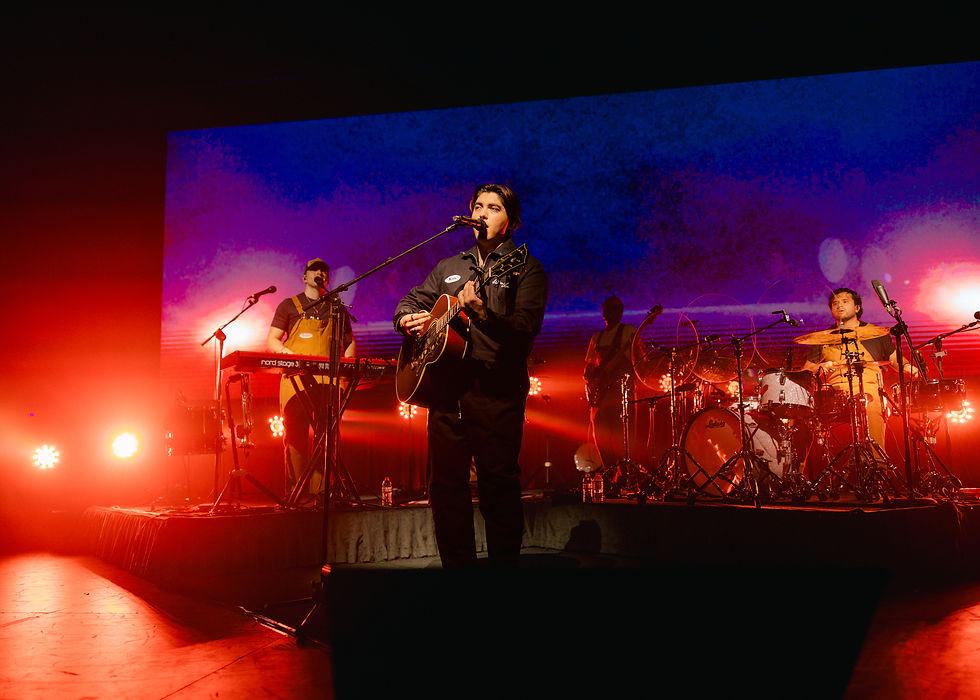
The visual production was understated, avoiding spectacle in favor of atmosphere. This restraint allowed the emotional weight of the music to remain at the forefront.
The audience — predominantly young adults and couples, many dressed in folk-inspired attire — engaged fully throughout. Their visible emotional responses suggested not mere fandom but identification with the narratives in Kaarl’s music. This was an audience that came to participate, not just observe. It was less a concert than a shared act of emotional translation — Kaarl providing the language, the crowd providing the lived memories.
Kaarl’s appearance at the Shrine marked both an expansion in scale and a consolidation of artistic identity. In an era when live music often leans on production excess, his ability to hold a large venue with minimal staging speaks to the strength of his songwriting and the conviction of his delivery. Even as he draws larger crowds, what remains unchanged is his capacity to create spaces where vulnerability feels not only safe but sacred. This night was a balm for broken hearts, a reminder that sadness and joy often share the same root, and that music can hold them both. It was a performance of precision, restraint, and resonance — qualities that will likely ensure his continued ascent on both sides of the border.

Written by: Ana Oquendo
Photographed by: Steven Esperanza for Goldenvoice